











A Beginner Guide to Exploring Whisk AI for Creative Visual Projects
Whisk AI is a free image generator that Google Labs made. The tool uses Gemini AI (Gemini Pro/Vision) for understanding images and Imagen 3 (or newer versions like Imagen 4) for generating high-quality images from visual prompts (subject, scene, style) and text. You can also create videos from the same generated images. In this guide, you are going to find out how to work with Whisk AI and explore its different features.
Generate Now!Part 1. How to Generate AI Images with Text Prompts in Whisk AI?
Google's experimental AI tool, Whisk, can quickly help you generate images with text prompts, and the steps are quite simple:
Step 1. Sign in to Your Account
You first need to set up Whisk AI, which is quite easy. First, go to the Whisk AI site by Google Labs, sign in to your account, and click Enter Tool.

Step 2. Type or Generate Your Prompts
Inside the tool, you will find the prompt box at the bottom center. Type in your prompt, whatever it is you want to generate. Alternatively, if you want something random, roll the dice, and it will create a prompt for you. You can keep clicking the dice button until you get something you like.
Step 3. Customize Image Settings
There is a button to select the aspect ratio as well. The default is 16:9, but you can also switch it to 1:1 or 9:16.
Then, over in the Settings, the Seed is unlocked by default, and that is probably best for most cases, so you leave it that way.
Step 4. Generate Your Images
Now, just click the arrow button. After a few seconds, you get two variations.
You can generate a few more if you are not satisfied with the result. To do this, just click on a variation and click Generate again.
If you enter a creative prompt without specifying a style or medium, Whisk may return different visual approaches. One variation might look like an illustration or cartoon, while another may look more photographic with a blurred background.
When you try something more detailed, Whisk can include era-specific elements if you ask for them. In group scenes, the generated results usually hold together well visually, although text details in the background may not be readable.
Step 5. Refine Your Generated Image
With a generated image, when you hover, you have this Refine button. Click that.
Now you are in a chat-to-edit kind of workflow. Here, you do have the preview image, but there is no dice for the prompt. Now you are going to tell it what you want to change, and Whisk AI will do that for you.
It makes a lot of other changes to the image. It does not just change one detail. It creates a whole new image, but everything is slightly different.
Since you are in Refine, which is this chat-to-edit workflow, you can keep making changes or adding things. You can add another object near the character. This time, it may maintain a bit more consistency between the second version and the third.
Step 6. Download Your Images
To download any variation of your image, click My Library at the top.
Here, you'll see your saved project. Click the three dots when you hover over an image, and click Download.
Part 2. How to Generate AI Images Using Reference Photos in Whisk?
You might have noticed the Add Images button down in the prompt box. With that, you can add reference images for the subject, scene, and style. Here's how to do this:
Step 1. Create a New Project and Add Images
In the first step, click the three lines in the top right corner to open the main settings and select New Project.
Then, in the prompt box, click Add Images.
Step 2. Describe Subject, Scene, and Style
Now, you'll see the Subject, Scene, and Style options in the left pane.
In every one of these options, you can either use text or upload an image to describe your subject, scene, and the style you are looking for. There is a button right next to the + icon, which you can use to generate AI styles, subjects, and scenes as well.
For example, you can upload a photo of a woman in the Subject and the blue dress in the Scene. Make sure to check these two, then describe your prompt that the woman is wearing the blue dress, and you get good results with two variations.
If you add a Style to the generated images via text prompt, reference image, or using the preset styles, check it as well, then you'll get two more variations. You'll notice that even if you leave the text prompts for the style, Whisk AI tries to match the style with the subject and the scene.
You can have more than one image in these categories. When generating, Whisk blends subject, scene, and style descriptions into the output.
Step 3. Refine and Download Your Images
Like before, hover over a generated image, click Refine, edit it with text prompts, and it will be saved under your library in the Images section to download.
However, this is not a way to get consistent characters or scenes. It does not combine those images into one image. It generates a description for each image you provide, and then uses those descriptions to generate an entirely new image.
Whisk says it is trying to capture some of the details from the images you provide and get the essence of the subject, scene, or style, but not all the characteristics and details. For example, if you provide one image as the subject and another image as the scene, then enter a prompt describing a person interacting with that scene and hit generate, the result will show similarities to both references. The subject may look somewhat similar, and the scene may resemble what you provided, but there will be differences. According to Whisk, this is expected behavior, and exact consistency is not the goal.
Part 3. What are the Preset Style Templates in Whisk AI?
There is probably more that can be explored by adding images in Whisk AI, but you get the idea of what is happening here. But there are preset style templates in the tool as well that you can leverage and use with the reference photos for the subject and scene. After creating a new project, you can select a template from the drop-down list.
Even if you leave the text prompt blank or don't describe the scene, Whisk AI does a pretty good job of understanding and generating the image.
Now, let's take a look at what these preset templates actually do.
Sticker
This preset makes your subject look like a flat image you'd peel and stick on a notebook or laptop. It simplifies the picture into graphic shapes and colors so it looks bold and clean, like a real sticker design. If you drop in a person, logo, or object, Whisk will produce something that looks ready to print as a sticker, with strong borders, clear shapes, and a simple graphic vibe. Basically, it turns your input into sticker art, not a photo-real scene.
Enamel Pin
This one gives you an image styled like a metal pin with colored enamel fill. Instead of a normal picture, Whisk makes the subject look like it's been turned into a collectible pin you'd attach to a jacket or bag, to be more of a fashion statement.
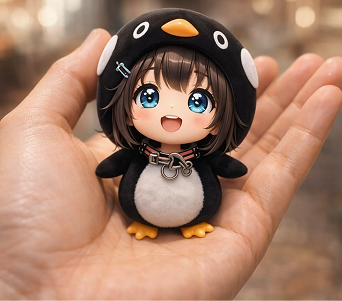
Plushie
Pick this, and Whisk AI makes something that looks like a cuddly stuffed toy version of your subject. Colors are softer, shapes are chunkier and rounder, and it looks like a physical plush doll you might see in a toy store display. It's like you told someone, "make this cute and soft," and they interpreted it as toy art.
Card
The card template gives you an image of the subject printed on a designed card. Not a real greeting card with text, but something that looks composed and framed. It often adds layout elements, decorative backgrounds, and a sense of intentional design you'd expect on printed cards. Think of it like a finished illustration you might put on a greeting card cover.
Chocolate Box
This style looks like what you'd see on a decorated chocolate box cover: artwork placed on packaging. The subject gets a kind of packaged look with fancy background and layout, as if your image belongs on a gift box of chocolates. The result looks playful and decorative, not photo-real.
Capsule Toy
The Capsule toy gives your subject the look of a tiny collectible toy that might come out of a vending machine capsule. The output looks toy-ish, rounded, simple, a bit cartoon-ish in design, and fun.
Bento Box
Bento box lays things out like pieces in a bento lunch box. Your subject gets arranged with other elements or patterns, creating grouped compositions that feel like assorted pieces. It doesn't actually draw real food, but the design looks like objects are organized together, like a visual set. This is great for showing multiple angles or versions in one image.
Part 4. How to Generate Video from a Generated Image in Whisk AI
Whisk AI has an Animate feature. It means image to video using V2. When you hover over a generated image, this button appears. Click the Animate button in the top left corner.
You can describe what you want to happen in the video, but that is optional. You can also let Whisk AI figure things out by itself and hit the Generate button, which is the arrow.
Then, wait for Whisk AI to do its magic. When the video is generated, click Play and preview it. You'll also notice that a background track is automatically added.
If you want to download the video, hover over it and click Download. You can choose to download it as a video or an animated GIF.
On the library page, you can find it under Videos.
Whisk gives you 10 free uses of the Animate feature in countries where the Animate feature is available. You may notice there is also some kind of limit on the number of images you can create as a free user, but that number is not clearly stated. There's a 10 videos per month limit. If you want to generate more than 10 videos or go beyond the free image limit, you need a Google AI subscription. There is a Pro plan at $19.99 per month, with the first month free, and an Ultra subscription at $249.99 per month, with the first three months priced at $124.99 per month.
Part 5. FAQs of Whisk AI
Q1. Is Whisk AI free?
A1. Yes, Google's Whisk image and video generator is generally free to use since it's a Google Labs experimental project. You can create static and dynamic visuals using images or text prompts, although there may be usage limits, such as 10 video generations at first. It works well for remixing styles and putting together simple visual storyboards.
Q2. Is Google Labs Whisk still accessible?
A2. At the moment, Google Whisk AI has been rolled out in roughly 100 countries under Google's creative experiment lineup. If Whisk is available where you live, you can use it as long as your account has access, since availability can vary by region and rollout status.
Conclusion on Whisk AI
That wraps up the quick walkthrough of Whisk AI. You've seen how the tool handles image generation, refinements, animations, reference images, styles, and presets, all inside one workspace. Since Whisk is still a Google Labs experimental project, it is more like a creative sandbox than a finished product, which makes it fun to explore without pressure. If you want to experiment with visuals, try different styles, or see how presets change results with just a few clicks, Whisk gives you plenty to play with while it's still free to use.

Home > Learn > A Beginner Guide to Exploring Whisk AI for Creative Visual Projects
Select the product rating:
Natalie Carter
Editor-in-Chief
My goal is to make technology feel less intimidating and more empowering. I believe digital creativity should be accessible to everyone, and I'm passionate about turning complex tools into clear, actionable guidance.
View all ArticlesLeave a Comment
Create your review for HitPaw articles